


Victims and Perpetrators: How Violence Repeats Within Family Systems—and How to Break the Cycle
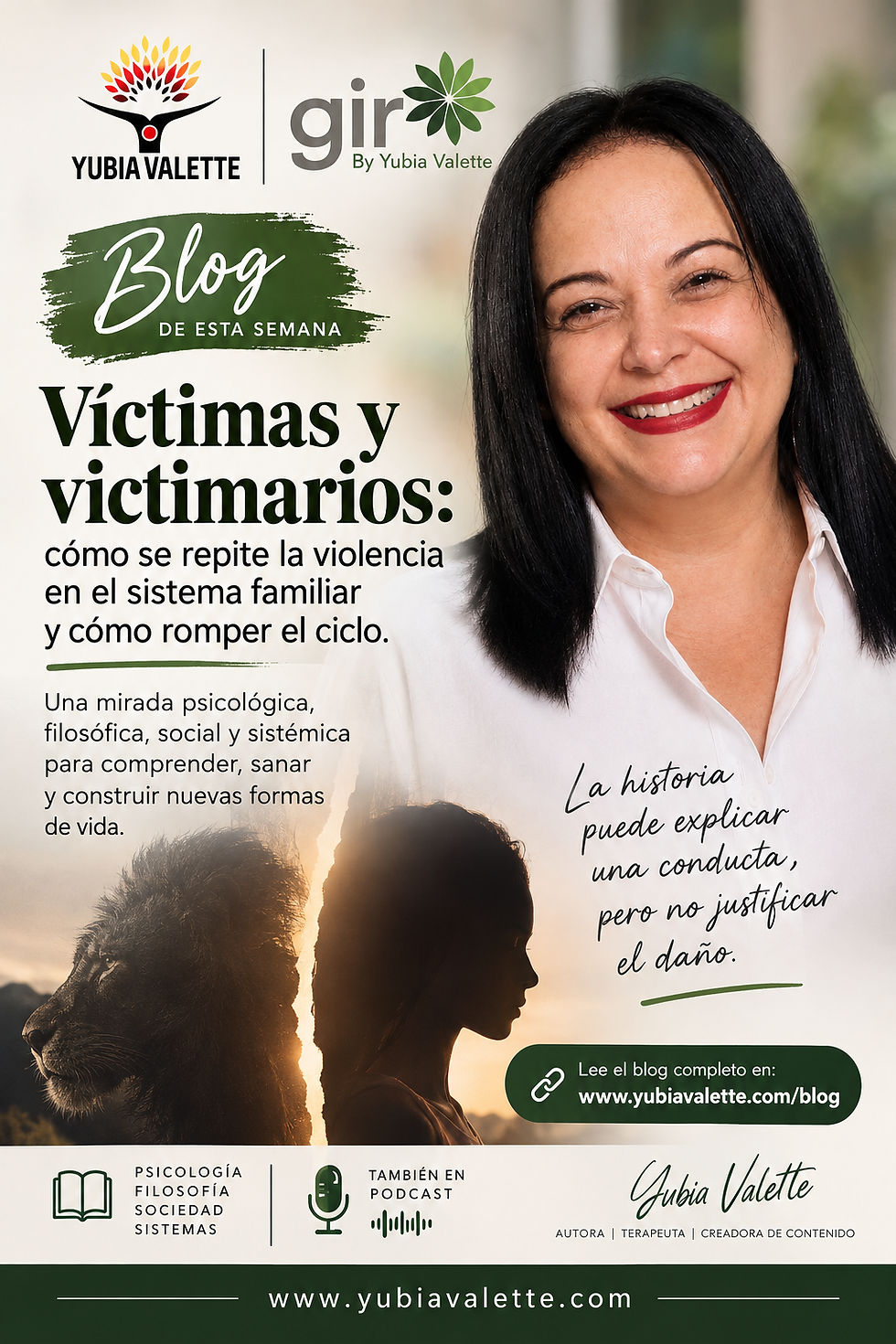
A psychological, philosophical, and systemic perspective on power, emotional wounds, invisible loyalties, and the responsibility to stop reproducing harm.
By Yubia Valette | Vuelta de Tuerca
Violence does not always begin with a punch. Sometimes it begins with an idea.
“If they get jealous, it means they love me.”
“In this family, things are done my way.”
“After everything I have suffered, I have the right to react like this.”
“I am the way I am because of what people did to me.”
“If I do not provoke them, they will not become violent.”
These statements may sound different, but they can share something dangerous: they make harm appear normal, inevitable, or deserved.
Violence does not always emerge suddenly. It may develop gradually through control, humiliation, isolation, intimidation, manipulation, threats, or repeated emotional degradation. When these behaviors become routine, the person experiencing them may begin to question their own perception, while the person causing harm may find explanations that help them avoid responsibility.
In my book Vuelta de Tuerca, the invitation is to look beyond comfortable explanations. Not to assign blame indiscriminately, but to understand how certain dynamics develop—and what it takes to interrupt them.
One distinction must remain clear from the beginning:
Understanding a perpetrator does not absolve them. Understanding a victim does not mean demanding that they prove why they did not leave. And experiencing violence does not give anyone permission to inflict it.
1. Does a victim choose their perpetrator?
This question requires a clear answer: people do not choose to be abused, assaulted, or murdered.
Asking why someone remains in a violent relationship can help us understand the psychological, economic, family, and social factors that make leaving difficult. But saying that a victim chooses their abuser can turn an attempt at understanding into an accusation.
Why, then, do some people enter or remain in relationships that become harmful?
There is no single explanation. Possible factors include:
Learning that love means sacrificing, enduring, or proving loyalty at any cost.
Confusing emotional intensity with intimacy, jealousy with care, or control with protection.
Fearing the loss of children, housing, income, community, or an emotional bond.
Depending financially on a partner or lacking a safe support network.
Facing threats against themselves, their children, relatives, or companion animals.
Hoping the other person will change after an apology, a promise, or a period of apparent calm.
Normalizing abuse because they witnessed it growing up or experienced it in previous relationships.
These factors do not apply to every situation, and they do not determine anyone’s future.
A person may also fail to recognize controlling behavior at the beginning of a relationship. It may start with attention, admiration, and closeness. Isolation, surveillance, restrictions, and threats can emerge later, when emotional bonds, shared responsibilities, or dependency have developed.
Instead of asking only, “Why did they choose that person?”, we need more useful questions:
What warning signs appeared? When did the dynamic change? What obstacles make leaving difficult? What resources would help the person become safer? Who is exercising control, and who has the power to cause harm?
Responsibility for violence belongs to the person who commits it. Understanding a victim’s choices and circumstances can help us offer better support; it does not make those choices the moral cause of the abuse.
2. The roles: victim, perpetrator, and witness
In a violent dynamic, different positions may emerge. Some people exercise control; others experience its consequences; others observe, minimize, justify, or remain silent.
Sometimes a person who experienced violence earlier in life may later reproduce harmful behavior in another relationship. That person may also choose to seek help, protect someone else, or challenge the patterns they learned.
But we must avoid a simplistic interpretation: the roles are not always equivalent or interchangeable.
In a relationship characterized by coercive control, for example, one person may systematically use threats, isolation, and surveillance. The other may shout, resist, or attempt to protect themselves. Describing both behaviors as if they necessarily represented the same kind of violence would erase the distinction between exercising control and responding to a threat.
Counting the arguments or raised voices is not enough. We must examine context, repetition, intent, power, consequences, and the fear that shapes the relationship.
Useful questions include:
Who has the power to impose the rules?
Who fears the consequences of saying no?
Who controls money, movement, relationships, or communication?
Who can leave without putting their safety at risk?
Who must constantly change their behavior to prevent an explosion?
Looking at roles is helpful when it clarifies responsibility. It becomes dangerous when abuse is reduced to a simple conflict between two equally powerful people.
3. The animal kingdom: Is violence natural?
Observing animal behavior can raise interesting questions about territory, competition, hierarchy, protection, reproduction, and survival.
Different species display forms of threat, competition, aggression, cooperation, caregiving, and conflict avoidance. The function of these behaviors depends on each species’ ecological and social context.
But there is a trap here: assuming that because a behavior exists in nature, it should be accepted in human society.
That confuses what happens with what ought to happen.
Human beings have capacities for reflection, language, moral learning, the creation of social norms, cooperation, and behavioral regulation. We also live within social structures that can legitimize or challenge inequality.
Observing aggression in other species does not prove that intimate partner violence is inevitable, that control is an expression of love, or that male domination is a natural law we must accept.
Nor can animal behavior be transferred mechanically to human relationships. Species, environments, and communication systems differ.
Animal behavior can serve as a metaphor for exploring competition, fear, defense, or belonging. It cannot serve as a justification for abuse.
The fact that something exists in nature does not make it an ethical rule.
To understand human violence, we must also examine learning, power relationships, gender norms, economic conditions, childhood experiences, and the institutions that tolerate or challenge harm.
4. The family as a system: What is learned, silenced, and repeated?
No person develops in isolation. Families, communities, schools, media, and institutions shape our ideas about love, authority, boundaries, and belonging.
In some family systems, obedience is taught as proof of love. In others, disagreement is treated as disrespect. In still others, protecting the family’s reputation matters more than listening to the person who is suffering.
These rules can be explicit or implicit:
“We do not talk about family problems outside the house.”
“A man must assert his authority.”
“Women must keep the family together, no matter what.”
“Children must forgive because he is their father.”
“This is how our family has always been.”
When such beliefs protect the aggressor, silence the victim, or prevent people from seeking help, they stop being simple customs. They can become mechanisms that sustain harm.
A systemic perspective invites us to explore how roles are assigned, who is allowed to express anger, who is expected to care for everyone else, who gets labeled as the problem, and which subjects cannot be discussed.
But one boundary is essential: a family pattern may help explain the context; it does not erase individual responsibility for violence.
Not every present-day difficulty comes from ancestral trauma. Not every repetition has a hidden family cause. And no interpretation involving invisible loyalties should be used to claim that a victim needed to experience abuse or had to remain in it to resolve a family history.
Systemic approaches and family constellations may be used cautiously as exploratory, symbolic, or experiential frameworks. They should not be presented as scientific proof of ancestral causes or as substitutes for appropriate assessment, protection, or professional care.
The question that opens a genuine turning point is this:
What did I learn about love, power, and boundaries—and what must I reconsider so that I do not keep reproducing what hurt me?
5. Violence against women and femicide: When control becomes dangerous
Violence against women cannot be reduced to a couple’s argument or a love story that went wrong.
It can include physical, sexual, and psychological violence, threats, harassment, isolation, and controlling behaviors. Femicide—the term used for certain gender-related killings of women—is one of the most extreme expressions of violence against women.
The World Health Organization identifies gender inequality, attitudes that justify violence, a sense of entitlement over a partner, and controlling behaviors among factors associated with intimate partner violence.
Jealousy is not proof of love. Constant monitoring is not protection. Demanding passwords, restricting friendships, controlling clothing, unilaterally managing money, threatening to take children away, or punishing someone for wanting to end a relationship are not healthy expressions of intimacy.
Not every relationship follows the same trajectory, and not every controlling behavior leads to femicide. Nevertheless, threats, escalating aggression, stalking, harassment, and fear surrounding separation must be taken seriously.
We must also recognize structural factors. Economic inequality, social tolerance of abuse, impunity, inaccessible services, and barriers to protection can increase vulnerability.
Understanding a perpetrator’s history may help inform prevention and treatment. It must never displace attention from the person at risk.
The priority is safety, protection, access to resources, and accountability for the person using violence.
A woman is not responsible for finding the perfect words to prevent someone else from harming her. Nor is she obligated to heal her partner’s trauma, prove that she loves them enough, or wait indefinitely for them to change.
6. Why do some people who experienced violence later inflict it?
Some people who experienced violence may repeat learned behaviors; others develop a firm commitment to opposing abuse. Many have complex experiences that do not fit a single pattern.
Experiencing violence does not automatically turn someone into a perpetrator.
Repetition may be associated with learned relationship models, difficulties regulating emotions, beliefs that normalize control, problematic substance use, social pressure, or a lack of tools for resolving conflict. None of these factors alone explains every case, and none excuses harmful behavior.
A painful history deserves to be heard. But listening does not mean granting permission to hurt others.
“I was hit, so I hit people” may describe a personal history; it does not justify the behavior.
“I never learned another way to express anger” may be the beginning of understanding; it is not the end of responsibility.
The adult question is: What will I do now with what happened to me?
I can seek help. I can learn to recognize the signs that my behavior is escalating. I can step away from an argument before threatening or assaulting someone. I can accept the consequences of my actions. I can recognize that the person I harmed is not obligated to forgive me or stay with me.
Breaking the cycle does not mean erasing the past. It means preventing the past from continuing to make decisions through our behavior.
7. Leaving a violent relationship is not simply a matter of “deciding to leave”
Telling someone, “If it is that bad, just leave,” sounds simple when we do not know their circumstances.
Leaving can be difficult and, in some situations, dangerous. There may be financial dependence, children, threats, surveillance, isolation, fear, disability, immigration-related barriers, or no safe place to go.
In some abusive relationships, separation can increase risk. It is therefore irresponsible to recommend an impulsive confrontation or insist that someone announce their plans without considering their safety.
Support is not pressure. It means listening without judgment, respecting the person’s pace, helping them identify options, and connecting them with specialized services.
If you are experiencing violence, consider seeking confidential support from professionals or specialized services in your area. If it is safe to do so, maintain access to important documents, trusted contacts, financial resources, and an emergency plan. If someone monitors your phone or accounts, use a safer device when seeking help.
If you are in immediate danger, contact your local emergency services.
Supporting someone also means not turning their experience into a spectacle, demanding details, revealing their identity without consent, or using their story as a moral lesson for others.
8. How can you break the cycle without becoming what hurt you?
Breaking the cycle does not mean never feeling anger, fear, or pain. It means learning to act without turning those emotions into permission to control or harm someone else.
You can begin with five steps:
1. Name what is happening.Distinguish disagreement, conflict, manipulation, intimidation, control, and violence. You do not have to wait for physical assault to recognize that something is unsafe.
2. Separate explanation from justification.Understanding why someone behaves a certain way does not require you to tolerate that behavior.
3. Rebuild boundaries and support.A boundary describes what you will do to protect yourself; it is not a formula for controlling another person. Seek people and services that respect your safety and autonomy.
4. Learn different ways to respond.If you recognize threatening, humiliating, monitoring, or intimidating behavior in yourself, seek specialized professional help and take responsibility. Promising that it will never happen again is not enough.
5. Measure change by actions.An apology may be a beginning, but it does not prove transformation by itself. Change requires sustained accountability, respect for boundaries, repair where possible, and no retaliation.
Setting boundaries is not the same as becoming an abuser. Saying no, ending a relationship, reporting abuse, or protecting your safety is not equivalent to threatening, stalking, humiliating, or exercising coercive control.
You do not have to become cold, vengeful, or cruel to stop being vulnerable.
Strength does not mean making someone else suffer what you suffered. It means refusing to turn your pain into a new source of harm.
9. A Vuelta de Tuerca exercise: Three positions, three questions
This exercise is a reflection tool, not a clinical assessment or a substitute for specialized care. Do not attempt it alongside someone who intimidates you if doing so could increase the danger.
Imagine three positions:
The person who experienced harm: What happened? What do I need to be safe? What support am I missing? What was not my responsibility?
The person who caused harm: What did I specifically do? What impact did it have? What excuses do I use? What verifiable actions must I take to stop the behavior and accept the consequences?
The adult witness: If I could observe the situation without denying the harm or excusing it, what facts would I see? What boundaries are needed? What resources and protective measures are necessary?
The purpose is not to exchange blame or demand that a victim understand the perpetrator. It is to recover a perspective that recognizes harm, distinguishes responsibilities, and identifies safe next steps.
If the exercise triggers intense memories or fear, stop and seek appropriate support.
10. The question that remains
A family can pass on affection, protection, values, and resources. It can also pass on silence, inequality, and ways of relating that normalize harm.
But no family history inevitably determines what we will do with our lives.
We do not choose every experience that shaped us. With support and responsibility, however, we can reconsider some of the responses we learned.
Not every victim becomes a perpetrator. Not every perpetrator was a victim. And not every story can be understood through a single explanation.
Complexity must not become moral confusion.
Violence may have a history, but its history does not turn it into a right.
Perhaps the real turning point is not discovering who is entirely to blame. Perhaps it is looking honestly at who holds power, who is being harmed, what sustains the dynamic, and what must change so that the harm does not continue.
Understanding is not absolution. Setting boundaries is not abuse. Protecting yourself is not betraying your family.
And breaking the cycle does not mean becoming the person who hurt you.
It means that your history may explain part of your journey, but it does not have to write every one of your next actions.
Resources and further reading
World Health Organization, Violence against women: https://www.who.int/news-room/fact-sheets/detail/violence-against-women
Ministry of Women of the Dominican Republic, *Línea Mujer 212: https://www.mujer.gob.do/index.php/servicios/linea-mujer-212
Related article by Yubia Valette: Belonging Has a Cost: Victims, Perpetrators, and Invisible Loyalties in the Family System. Original Spanish article: https://www.yubiavalette.com/post/pertenecer-cuesta-v%C3%ADctimas-victimarios-y-lealtades-invisibles-en-el-sistema-familiar
An ethical note
This article is educational and does not replace psychological or legal advice or specialized violence-related services. Victims’ experiences vary; no systemic, psychological, or spiritual interpretation should be used to make them responsible for abuse. References to family dynamics or family constellations are exploratory and do not establish ancestral causes of violence.
Ready to look at your story from a different angle?
If you want to understand relationship patterns, reconsider boundaries, or explore new ways to respond to conflict, you can learn more about Yubia Valette’s work and human-development resources.
WhatsApp: +1 829-344-1166Website and blog: https://www.yubiavalette.com
If you are in danger, prioritize your safety and contact emergency services or specialized support in your area.
Comentarios