


WHAT IF BEING “THE GOOD ONE” IS THE MOST ELEGANT WAY OF ABANDONING YOURSELF?
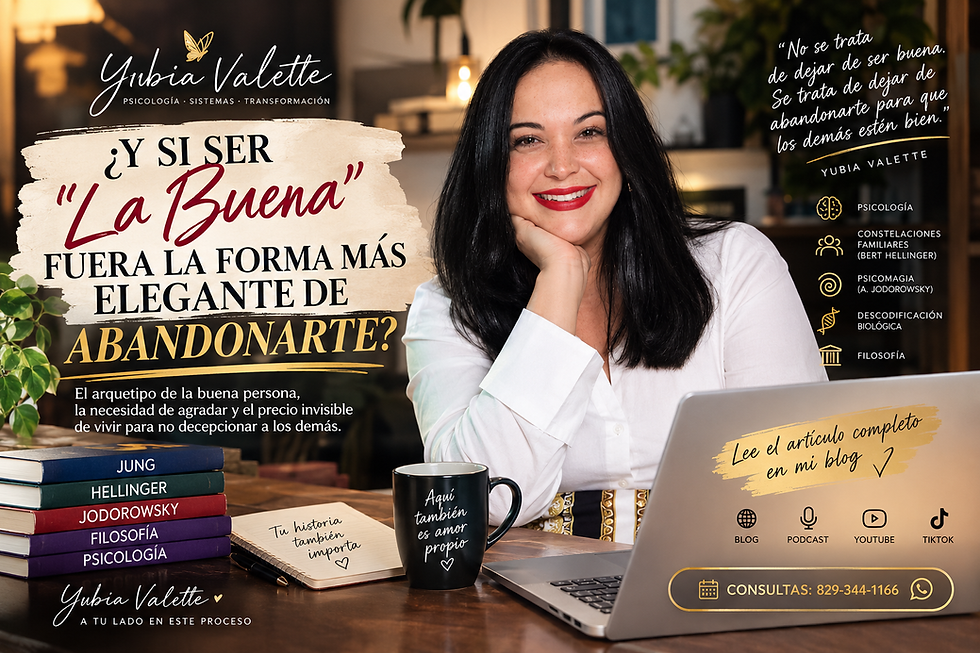
The hidden archetype of the good person, people-pleasing, family roles, boundaries and the invisible cost of living so nobody else gets disappointed.
There are people who enter a room and immediately notice everyone else.
Who needs something?
Who looks uncomfortable?
Who is upset?
Who needs help?
Who needs reassurance?
They know.
They are the helpers.
The listeners.
The problem-solvers.
The forgiving ones.
The responsible ones.
And they often hear:
“You are such a good person.”
But what if we asked a different question?
What if being “the good one” has become a beautiful way of abandoning yourself?
BEING GOOD IS NOT THE PROBLEM
Kindness is not the problem.
Generosity is not the problem.
Empathy is not the problem.
Caring is not the problem.
The question is:
Is your kindness still a choice?
Or are you afraid of what might happen if you stop giving?
Contemporary research is beginning to distinguish people-pleasing from general agreeableness or empathy and to examine the tendency to prioritize others' needs over one's own.
So ask yourself:
Am I helping because I want to—or because I am afraid of what will happen if I don't?
THE GOOD ONE AS AN ARCHETYPE
The word archetype comes through Latin from Greek arkhetypos, associated with the idea of a first form, model or original pattern.
In Jungian psychology, the concept became associated with symbolic patterns and images of the collective unconscious.
So here, “The Good One” is not a diagnosis.
It is a symbolic character.
The person who learned:
If I am good, I belong.
THE PSYCHOLOGY OF PEOPLE-PLEASING
Beverly Engel's The Nice Girl Syndrome directly explores people-pleasing, fear of rejection, guilt, confrontation and boundary difficulties.
Spanish psychologist and psychotherapist Marta Martínez Novoa has explored the same territory for Spanish-speaking audiences in El síndrome de la chica buena.
But the more important question is:
What purpose did this behavior once serve?
Perhaps saying yes helped you preserve connection.
Perhaps being useful helped you feel valuable.
Perhaps staying quiet helped you avoid conflict.
That does not mean everyone who people-pleases had a traumatic childhood.
There is no single universal explanation.
But there may be a personal story worth exploring.
FAMILY SYSTEMS AND BERT HELLINGER
Bert Hellinger developed Family Constellations, a systemic approach focused on family relationships and patterns.
Research has investigated the approach, but a systematic review concluded that the overall quantity and quality of evidence remain low.
So we should not use Family Constellations to declare:
“Your illness comes from your grandmother.”
or:
“You inherited this destiny.”
Instead, we can ask:
What role did you learn to occupy in your family?
Were you:
the responsible one?
the mediator?
the caretaker?
the child who never caused trouble?
the one who kept everyone together?
That question opens exploration rather than imposing a conclusion.
JUNG AND THE SHADOW
If your identity says:
“I am the good one.”
Where do you put:
your anger?
your ambition?
your exhaustion?
your desire?
your sexuality?
your disagreement?
your needs?
your NO?
Jung's concept of the shadow can be used here as a symbolic framework for exploring parts of ourselves that don't fit the identity we consciously maintain.
Perhaps the hidden part of you isn't bad.
Perhaps it is simply saying:
“I exist too.”
JODOROWSKY AND PSYCHOMAGIC
Alejandro Jodorowsky developed psychomagic as a symbolic practice involving concrete actions and the language of the unconscious. His published work emphasizes understanding the meaning of symbolic actions rather than simply believing in superstition.
We should not present psychomagic as evidence-based medical treatment.
But we can borrow the idea of symbolic action.
Write:
I DO NOT NEED TO ABANDON MYSELF TO BELONG.
Then write:
“Today I will choose one thing because I genuinely want to—not because I am afraid.”
Not magic.
A conscious symbolic act.
BIOLOGICAL DECODING: AN IMPORTANT BOUNDARY
Biological Decoding and related approaches attempt to connect illness or symptoms with emotional conflicts.
These explanations should not be presented as established medical diagnoses or substitutes for healthcare.
So we will not say:
“Your illness happened because you couldn't say no.”
We can ask:
“What emotional meaning does this experience have for you?”
One statement claims to explain disease.
The other opens reflection.
THE PHILOSOPHICAL QUESTION
Who are you when nobody approves?
Who are you when someone is disappointed?
Who are you when you are not solving anything?
Who are you when you say no?
Maybe freedom does not mean making everyone understand your decisions.
Maybe freedom means being able to live with your decisions even when someone else doesn't understand them.
THREE COMPOSITE CASES
These are composite educational cases, not literal patient testimonials.
Maria
She knew exactly what everyone else needed.
But when asked:
“What do you need?”
she had no answer.
Her work was not to become less kind.
It was to recover the ability to choose.
Carlos
He was the man who could handle everything.
Work.
Money.
Family.
Problems.
But he could not ask for help.
For him, needing someone meant weakness.
The question became:
“Who are you when you are not the one who solves everything?”
Ana
She described herself as “very generous.”
But she repeatedly agreed to things she did not want.
Then she felt that everyone took advantage of her.
The question was:
“Where does the other person's responsibility end—and yours begin?”
THE TRANSFORMATION
Not:
GOOD → BAD
But:
GOOD OUT OF FEAR → GOOD BY CHOICE
From:
“I have to help.”
to:
“I choose to help.”
From:
“I cannot disappoint you.”
to:
“I can tolerate your disappointment.”
From:
“I need you to need me.”
to:
“I can love without becoming indispensable.”
From:
“No makes me selfish.”
to:
“No can be an act of honesty.”
FIVE QUESTIONS
Complete these sentences:
If I stop solving everyone's problems, I am afraid that…
If someone is disappointed in me, I am afraid that…
If I say no, I am afraid that…
If I stop being needed, I am afraid that…
And:
If I no longer needed to be “the good one,” I could…
Stay with that last answer.
MY INVITATION
You don't have to become harder.
You may simply need to become freer.
Free to help.
Free to say no.
Free to love.
Free to rest.
Free to disappoint.
Free to choose.
If this article made you recognize something in yourself, we can explore it together.

Comentarios